
A fixed round cost can leave part of a spending boundary unused
Published — UTC

A spending boundary does not have to be exhausted exactly. If a whole accepted round costs more than the amount remaining, the unused remainder is not an instruction to start a partial round.
Whole rounds under an invented boundary
For this arithmetic example, a reader has chosen an 11-unit cost boundary. Each accepted round has a fixed 3-unit cost, with no extra features or price changes.
| Completed accepted rounds | Cumulative cost | Amount below boundary |
|---|---|---|
| 1 | 3 | 8 |
| 2 | 6 | 5 |
| 3 | 9 | 2 |
| 4 | 12 | Exceeds by 1 |
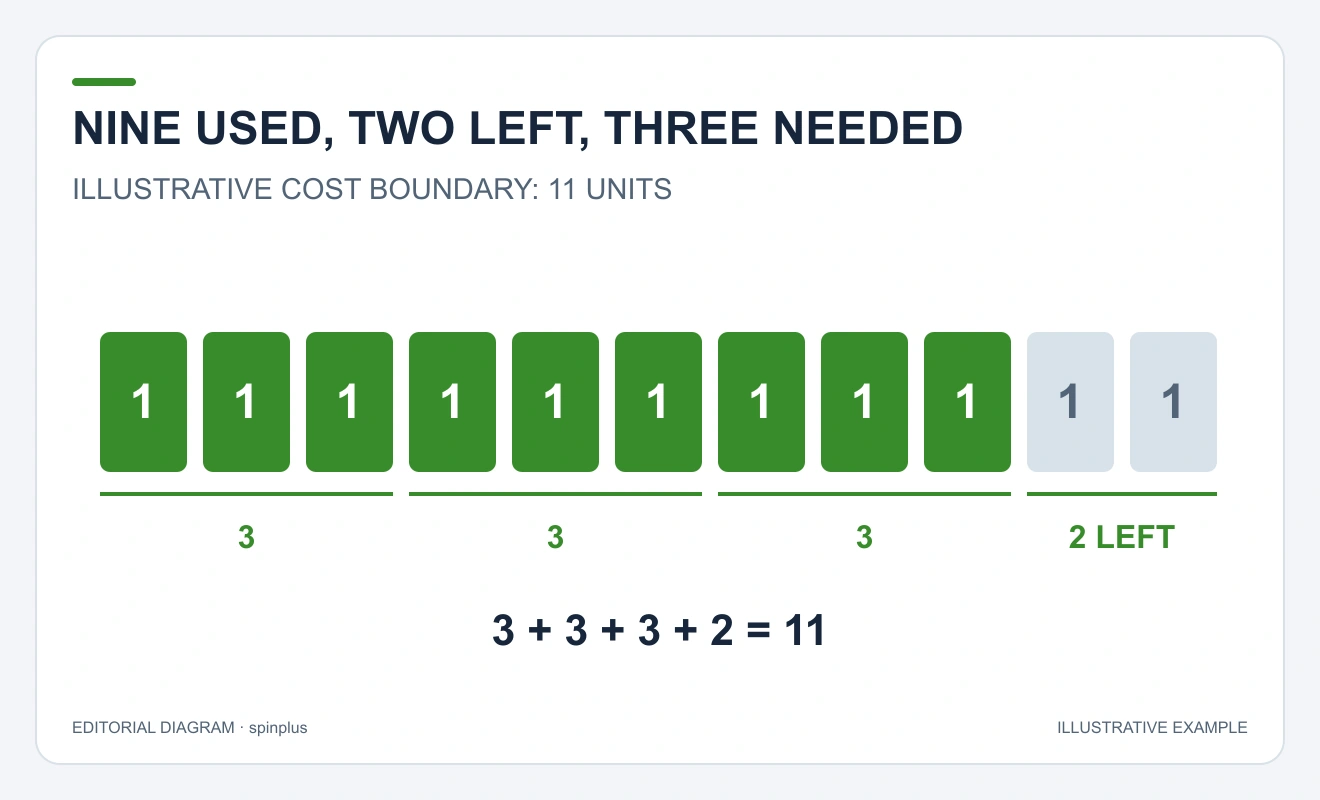
Three whole rounds fit; four do not. The remaining 2 units cannot fund the defined 3-unit round. This is a boundary calculation, not a recommendation to play three rounds or change the stake to use the remainder.
Returns do not erase accepted cost
If a round returns an award, its accepted cost still belongs to this cost-based boundary. A net-loss boundary would be another definition. Do not switch definitions midway because the displayed balance has increased.
The British financial-limit reference distinguishes types of limits. It does not confirm how a local account tool enforces a chosen boundary.
The remainder is an arithmetic result
In this fixed-cost model, 11 = 3 × 3 + 2. The whole-number quotient gives the maximum number of complete 3-unit costs that fit, and the remainder gives the unused amount. It is a feasibility check, not a target for how much to spend. Stopping before the boundary remains possible.
Do not substitute wallet balance for cumulative cost
Suppose the wallet starts at 20 and those three rounds return 5 units altogether. The wallet becomes 20 − 9 + 5 = 16. Gross accepted cost is still 9; net loss is 4; the wallet is 16. These three figures answer different questions. Using the 16-unit balance as the amount remaining under the 11-unit cost boundary would ignore its definition.
A changed cost needs a new comparison
If the actual accepted costs were 3, 4 and 3, the total would be 10 and the remainder 1. Multiplying the last cost by three would incorrectly report 9. If a record adds a separately accepted feature cost, include it according to the boundary’s stated scope; a label such as “one round” does not establish the complete amount charged.
A pending debit also needs a status. It is not evidence of a settled charge, but treating it as definitely nonexistent can understate possible committed cost. Keep confirmed costs and unresolved commitments in separate columns until the records settle. Do not initiate another round to investigate the difference.
Keep the period and coverage fixed
An illustrative daily boundary with 2 units remaining and a weekly boundary with 1 unit remaining cannot be summarized as 3 available units. The same prospective cost must satisfy each applicable boundary; the remaining amounts are not added together. Record the start and end of each period, its time zone and the products included. This arithmetic does not establish what a particular account control will enforce.