
HB 11566, the SAFE Kids Act: what the House-approved bill means for online games, and what it leaves to PAGCOR

Short answer — On 12 October 2026 the House of Representatives approved House Bill No. 11566, the “Safe and Friendly Environment for Kids in Digital Spaces (SAFE Kids) Act”, on third and final reading — 287–3–0 according to BusinessWorld and The Manila Times, 288–3–0 according to ABS-CBN. The House’s third-reading text bars children under 13 from social media and from the social features of online games, lets 13 to 17-year-olds in only with parental consent and a list of 12 restricted features — including “gambling-like mechanisms” and purchases — and sets fines of up to ₱20 million per violation. It is not law yet: the Senate passed a different version, and the two must be reconciled.
For readers of a games site the question is practical: does this touch online casino games, slot apps or ordinary mobile games? We read all 45 sections of the House text. Below is what it says about online gaming, where it stops, and what parents can do now.
What exactly did the House pass?
HB 11566 is a consolidated bill; the third-reading copy lists 117 House members as authors. Its title is “An Act Establishing Safety Standards and Regulatory Measures to Protect Children on Social Media and Online Gaming Platforms”. The main rules in the third-reading text:
| Rule | What the text says | Section |
|---|---|---|
| Under 13 | No account or access on social media, look-alike services, app stores, or the social and interactive features of online games; existing accounts disabled | 5 |
| 13 to 17 | Access with parental consent; 12 categories restricted, incl. ads, recommendations, livestreaming, endless scrolling, “shorts”, profiling, purchases and gambling-like mechanisms | 6 |
| Age checks | Platforms must run an Age Assurance framework and re-verify users’ age at least twice a year; a typed birth date alone is not enough | 16 |
| PhilSys option | Age can be checked through PhilSys or e-Verify without platforms keeping the ID; alternatives required for people without a PhilSys record | 24 |
| Regulator | A new SAFE Kids Office under the DICT; fines decided by the NTC | 8, 11 |
| Local presence | Foreign platforms register with the SEC within 90 days of a coverage notice and name a resident compliance officer | 13 |
| Parents | Expected to guide and report; no fine on parents just because a child used a platform | 17, 37 |
Does it cover online games — and online casinos?
This is the part most coverage skips. Section 3 defines an “Online Gaming Platform” broadly: any service that lets users access or play online games, including chat, sharing, livestreaming and other interactive features. But Section 4 narrows it sharply. An online gaming platform is covered only for its social, communication, content-sharing, livestreaming, user-interaction, recommender or other interactive features. Section 20 repeats the limit: nothing in it regulates “the core gameplay, game mechanics, or other functions” of a game that do not involve the prohibited features.
Section 4 also states that the Act does not diminish or transfer the existing jurisdiction of PAGCOR, the Games and Amusements Board or the MTRCB, except for child-safety risks from the covered social features. In plain terms:
- Real-money casino games and slots stay under PAGCOR’s rules. PAGCOR already limits licensed gaming to adults 21 and over — far above the bill’s 13 and 18 thresholds — so a licensed casino site should not have child users at all.
- Ordinary mobile and console games with chat, voice, livestreams or friend lists would have to switch those features off for under-13s and restrict them for 13–17s.
- Game mechanics that look like gambling inside non-gambling games — the text says “gambling-like mechanisms”, without defining them further — must be disabled for 13 to 17-year-old users (Sections 6, 19 and 20). The definitions section does not list examples; the SAFE Kids Office would have to spell out what counts.
That last point is the one with real reach for the games industry. Paid random rewards, spin-to-win wheels and purchasable chances in games aimed at teenagers would likely be tested against it. Until the implementing rules exist, which features qualify is an open question, and we do not guess at it.
What would online gaming platforms have to do?
For their social and interactive features, Section 20 lists ten duties for online gaming platforms. The core ones:
- Apply the age limits and treat a user as the younger age group until age is verified.
- Block harmful or prohibited content sent through text, voice, images or video.
- Prohibit direct communication with other users and with AI systems for child users.
- Prohibit livestreaming, endless scrolling and short-video feeds where those exist, and limit other features that encourage “prolonged, repetitive, or difficult-to-control use”.
- Disable targeted advertising, profiling, purchases and gambling-like mechanisms for children.
- Run and update a Child Safety Risk Assessment, and keep human oversight of automated systems.
Section 21 closes the usual escape routes: a platform cannot avoid liability because a child lied about their age, because a fake parent gave consent, or because its terms of service already ban children.
How big are the penalties? (our calculation)
Section 32 sets two scales of fines, imposed by the NTC after a hearing:
| Type of violation | 1st | 2nd | 3rd and later |
|---|---|---|---|
| Procedural (registration, reports, compliance officer) | ₱100,000–₱500,000 | ₱500,000–₱1M | ₱1M–₱2M |
| Child-safety duties (age checks, safe defaults, risk features) | ₱2M–₱5M | ₱5M–₱10M | ₱10M–₱20M |
| Continuing violation after the deadline (Sec. 33) | ₱100,000 to ₱1M per day until compliance | ||
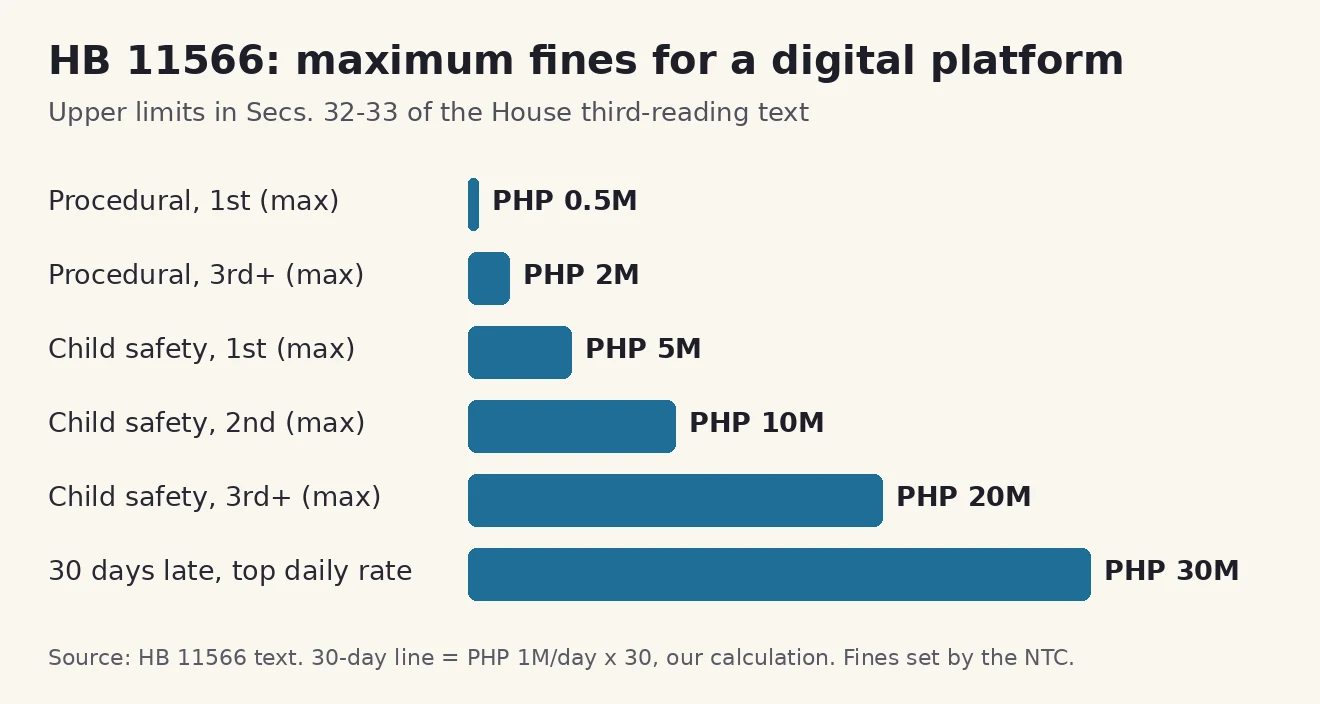
By our calculation, the daily fine is where the money adds up. A platform that ignores a final order for 30 days faces ₱3 million at the lowest daily rate and ₱30 million at the highest — more than the ₱20 million ceiling for a third child-safety violation. A platform that keeps failing can also have access restricted in the Philippines until it complies, or be barred from operating after repeated serious violations (Section 35). Fines go to the National Treasury.
House vs Senate: what still has to happen
The Senate has approved its own measure, SB 2424 or the SMART KIDS Act, according to The Manila Times. That report says the Senate version uses a strict under-18 restriction, while the House uses the tiered 13-and-17 model; a bicameral conference must reconcile them before anything goes to the President. We have not read the Senate text ourselves, so we do not compare clause by clause.
If a final version keeps the House timetable, the Act would take effect 15 days after publication (Sec. 45), the DICT and NTC would issue implementing rules within 90 days (Sec. 41), and the DICT would set up the office within 120 days (Sec. 42). By our arithmetic that is roughly four months from publication before the full machinery is in place.
What parents and players can do now
- Real-money gaming is already 21+. Under PAGCOR’s framework, no child should be on a licensed casino or slot platform; report sites that let minors in. PAGCOR’s responsible gaming page explains family exclusion, which lets a parent, spouse or child apply to bar a relative.
- Use the settings that already exist. Most game consoles and app stores have parental controls for chat, purchases and screen time; the bill would make some of these defaults, but they can be switched on today.
- Watch for spend-to-win features. Whatever the final definition of “gambling-like mechanisms”, in-game purchases tied to random rewards are the features to check first in a child’s games.
What is not confirmed
- The exact vote: BusinessWorld and The Manila Times report 287–3–0; ABS-CBN reports 288 in favour. We could not open the House’s own voting record (the legislative site blocked automated access on 22 October 2026).
- The definition of “gambling-like mechanisms”, which the text leaves to implementing rules.
- The final age thresholds and penalties after the bicameral conference.
Sources (checked 22 October 2026): House Bill No. 11566 third-reading text, House of Representatives document server (scanned; read by us); BusinessWorld, 12 October 2026, and The Manila Times, 14 October 2026 (reported vote and Senate version); PAGCOR responsible gaming page. The 30-day fine figures and the implementation timeline are our own calculation from the bill text.